
CEOs, An Important Reminder as You Lead in the Age of AI
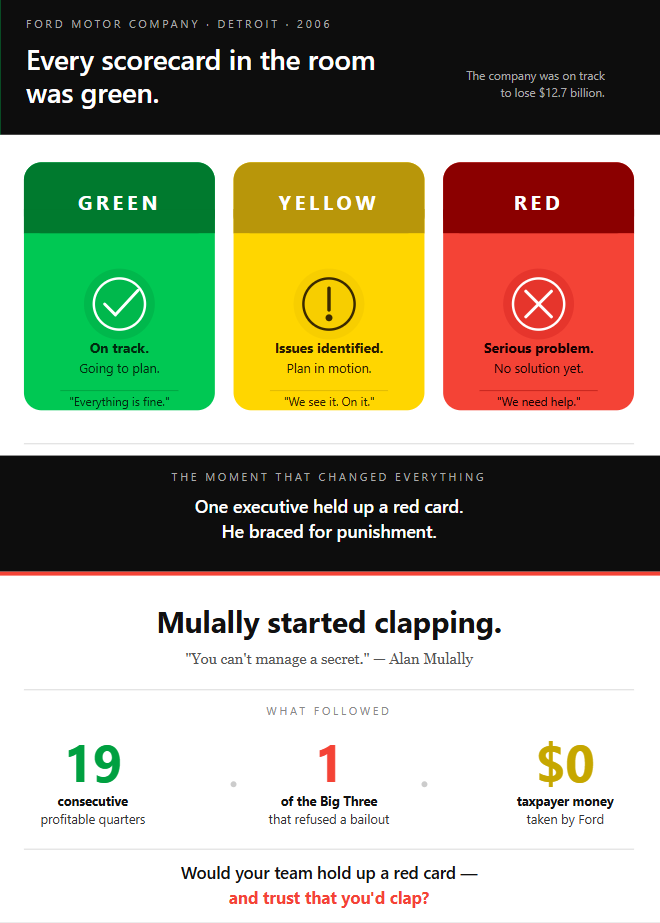
Some of you will remember that in 2006, Ford was preparing to post a $12.7 billion annual loss, the largest in its history. The company was in serious trouble. And yet, inside the executive meetings you would have never known.
Alan Mulally had just stepped in as CEO.
He brought his senior team together for a weekly meeting that would become the heartbeat of the company, the Business Plan Review (BPR). Same room. Same time. No exceptions.
One by one, each leader presented their results.
On track.
No issues.
Everything was fine.
For a company losing billions.
Mulally sat there and took it in. This wasn’t a strategy problem.
It was a truth problem.
Ford had become a system where it was safer to protect appearances than to face reality.
Silos had formed.
Leaders protected their domains.
And bad news stayed buried.
So Mulally changed something fundamental. He introduced a simple communication structure:
From that point forward, every leader would report using three colors:
🟢 Green, we are on track
🟡 Yellow, we have issues but a plan to address them
🔴 Red, we have serious problems without a clear solution
Week after week, nothing changed. Still all green. Until one moment, one executive finally put up a red. That executive was Mark Fields, who at the time was running Ford’s Americas division (who later became CEO of Ford). A real issue. No solution yet.
You can imagine the room. Silence. Tension. Anticipation. This was the test.
What happens when the truth shows up?
Mulally started clapping. “Great visibility,” he said. Then he asked the question that defines great leadership: “Who can help him?”
That moment changed everything.
Mulally often said, “You can’t manage a secret.”
But what he really created was something deeper. A system where people no longer needed to keep them.
Within weeks, the dashboards changed. Green gave way to yellow. Yellow to red. Not because performance declined. Because honesty finally had a place to land. And from there, performance followed.
Ford returned to profitability in 2009 and continued from there, while competitors like GM and Chrysler went through government-backed restructuring.
The strategy mattered. But this is what unlocked it:
He made it safe to tell the truth.
Now, fast forward.
We are in the early innings of AI. Eighty eight percent of organizations are already using it.
Pilots are running.
Capabilities are expanding.
Progress is being reported.
But as you sit in executive meetings today, notice, does it all look… green?
McKinsey’s research indicates, at least currently (things change fast these days) that very little is meaningfully shifting the bottom line. Most organizations are not seeing material EBIT impact from AI. And the biggest differentiator for those that do is not better technology.
It is leadership.
Workflow redesign.
CEO ownership.
Organizational alignment.
In other words:
Not what you’ve implemented.
But what you are able to see and willing to communicate.
And what your team feels safe enough to tell you.
Because the real barriers to AI transformation (or any other large change initiative) are rarely technical.
They are human.
Unspoken resistance.
Misaligned incentives.
Broken processes.
And conversations that never happen.
The modern version of “everything is green.”
So, here is the question that matters now:
Not, does your team understand AI.
But this:
If something in your AI systems was failing, exposing your organization to risk, or impacting people in ways you didn’t intend, would someone on your team put up a red in front of you? And trust that you would meet it with curiosity, not consequence?
Because success leaves clues. And this one is consistent across every great transformation. The organizations that win are not the ones with the best strategy. They are the ones where the truth is communicated and addressed fastest.
Sources
McKinsey & Company — Alan Mulally interview and State of AI research
https://www.mckinsey.com/capabilities/strategy-and-corporate-finance/our-insights/leading-in-the-21st-century-an-interview-with-fords-alan-mulally
https://www.mckinsey.com/capabilities/quantumblack/our-insights/the-state-of-ai
Harvard Business Review — Ford leadership practices
https://hbr.org/2010/12/how-ford-24-hour-rule
IMD — Ford transformation case insights
https://www.imd.org/ibyimd/audio-articles/how-ceos-drive-saved-car-giant-ford-from-the-scrapyard/
U.S. Treasury — Auto industry crisis context
https://home.treasury.gov/data/troubled-assets-relief-program/automotive-programs/overview

Susanne Biro is an executive coach with over two decades of international experience working with CEOs, executive-level leaders, and their teams at some of the world’s most respected organizations. Her work focuses on elevating executive effectiveness, communication, and whole-life success.
- NEW Book: This Could Be Everything
- App: Inner Life Leadership
- Podcast: Deep Fear Podcast
Susanne can be reached at susanne@susannebiro.com